World Architecture
Why the world is building 20-storey towers out of wood again
Norway, the United States and Australia now have residential towers with a timber structure. The reason is carbon — and the material is not the timber you are thinking of.
The buildings
In 2019, an 18-storey mixed-use tower called Mjøstårnet opened in the small town of Brumunddal, Norway. At just over 85 metres it was, at the time, the tallest timber building in the world. Its columns, beams and bracing are glued laminated timber; its floors are cross-laminated timber panels.
In 2022, Ascent in Milwaukee, in the United States, went slightly higher — a 25-storey apartment building with a mass-timber frame above a concrete base. Several European cities have mid-rise timber apartment blocks as a matter of routine now, and building codes in the US, Canada and Europe have been rewritten in the last decade to allow it.
What “mass timber” actually is
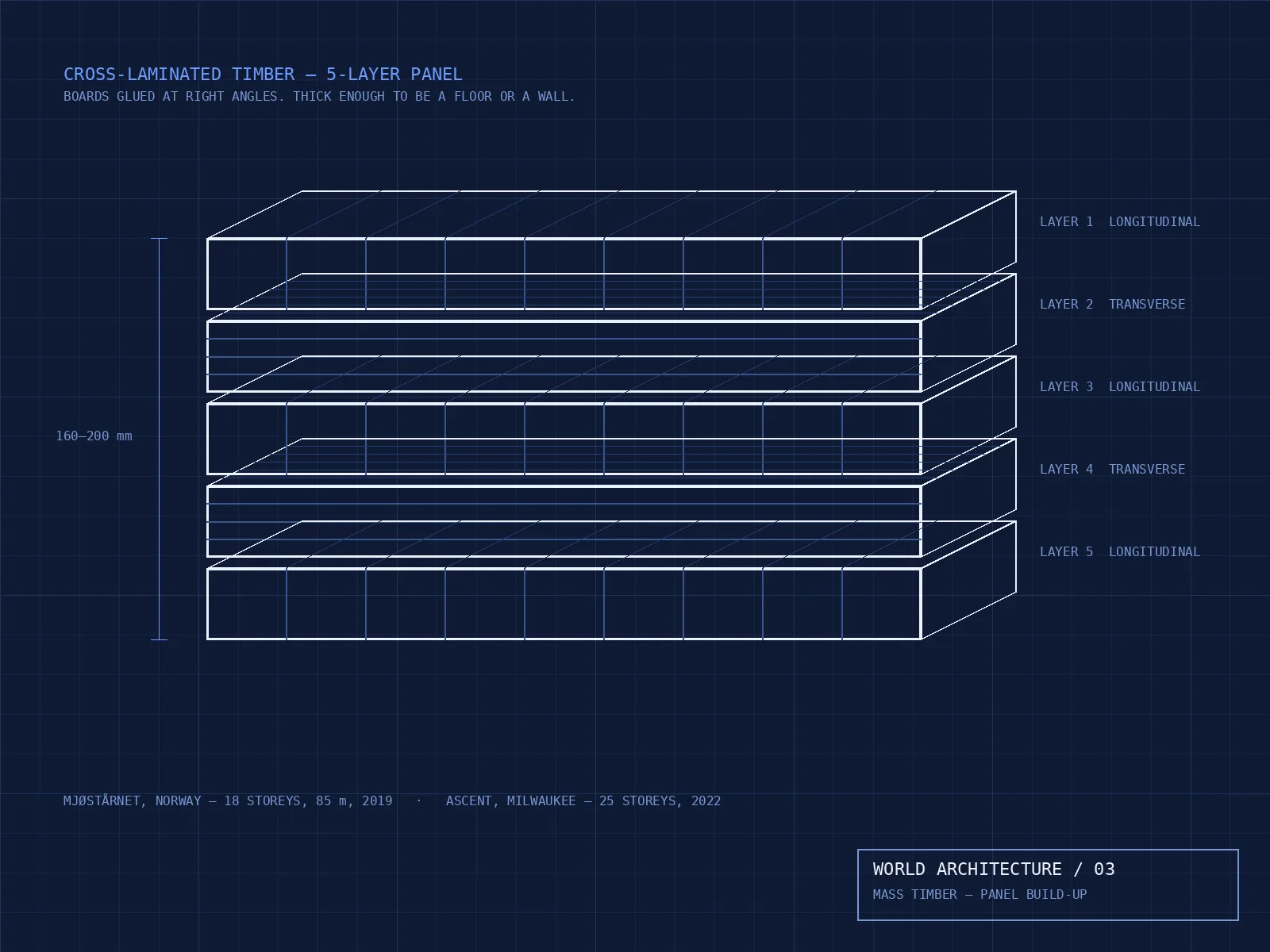
This is not ordinary sawn wood. Cross-laminated timber (CLT) is made by gluing layers of boards at right angles to each other, like plywood but thick enough to be a floor slab or a load-bearing wall. Glulam is the same idea for beams and columns. The panels are made in a factory, cut by machine to the exact drawing, and arrive on site ready to lift into place.
Because the material is engineered, it is predictable. Because the sections are large, it behaves well in a fire: the outer layer chars and the char protects the wood behind it, so the structure keeps its strength for a rated time. Fire engineers, not marketing people, are the ones who signed off on Mjøstårnet.
Why anyone bothers
Concrete and steel are responsible for a large share of the world’s construction carbon. Timber stores carbon instead of releasing it, and a factory-cut frame goes up faster with fewer people on site. In countries with managed forests, it is also getting cheaper relative to steel.
What it means here
Honestly: not a timber tower in Dhaka any time soon. Bangladesh does not have the forestry, the factories or the fire code for it, and reinforced concrete is the right answer for our soil, our climate and our builders.
But two things travel.
The first is prefabrication. The reason Ascent went up quickly is that its structure was made to the drawing, in a factory, before anyone stood on site. We already see this in precast elements and in the way we coordinate structural and architectural drawings before the site team gets them. The less that is decided on site, the fewer surprises.
The second is that codes change. Twenty years ago a wooden tower was illegal almost everywhere. It became legal because engineers demonstrated, test by test, that it was safe. Bangladesh’s own building code is revised the same way — and every well-documented, properly tested building adds to the case for the next one.