World Architecture
Tropical modernism: what Bawa's Sri Lanka and Kahn's Dhaka still teach a family house
The best hot-climate architecture of the last century was not about air conditioning. It was about shade, air and water — and most of it was built within a few hundred kilometres of here.
Two names worth knowing
Geoffrey Bawa (1919–2003) was a Sri Lankan architect who spent forty years working out how a modern building should behave in a monsoon climate. His houses and hotels — the Kandalama Hotel, the Lunuganga estate, his own house in Colombo — use deep verandas, internal courtyards, open corridors and ponds, so that a room is rarely more than a few steps from shade and moving air. Walls are often left open to the weather on purpose.
Louis Kahn designed the Jatiya Sangsad Bhaban, Bangladesh’s National Parliament in Sher-e-Bangla Nagar, Dhaka. Begun in the 1960s and completed in 1982, it is one of the most admired buildings of the twentieth century anywhere in the world. Its huge geometric openings are not windows in the ordinary sense. They are cut into thick concrete walls so that light comes in bounced and softened, while direct sun and rain stay out. The whole complex sits in water, which cools the air around it.
Both architects were solving the same brief a client in Cumilla or Sylhet brings us today: heat, humidity, hard rain, and a wish for the house to feel open rather than sealed.
Five ideas that survive the trip
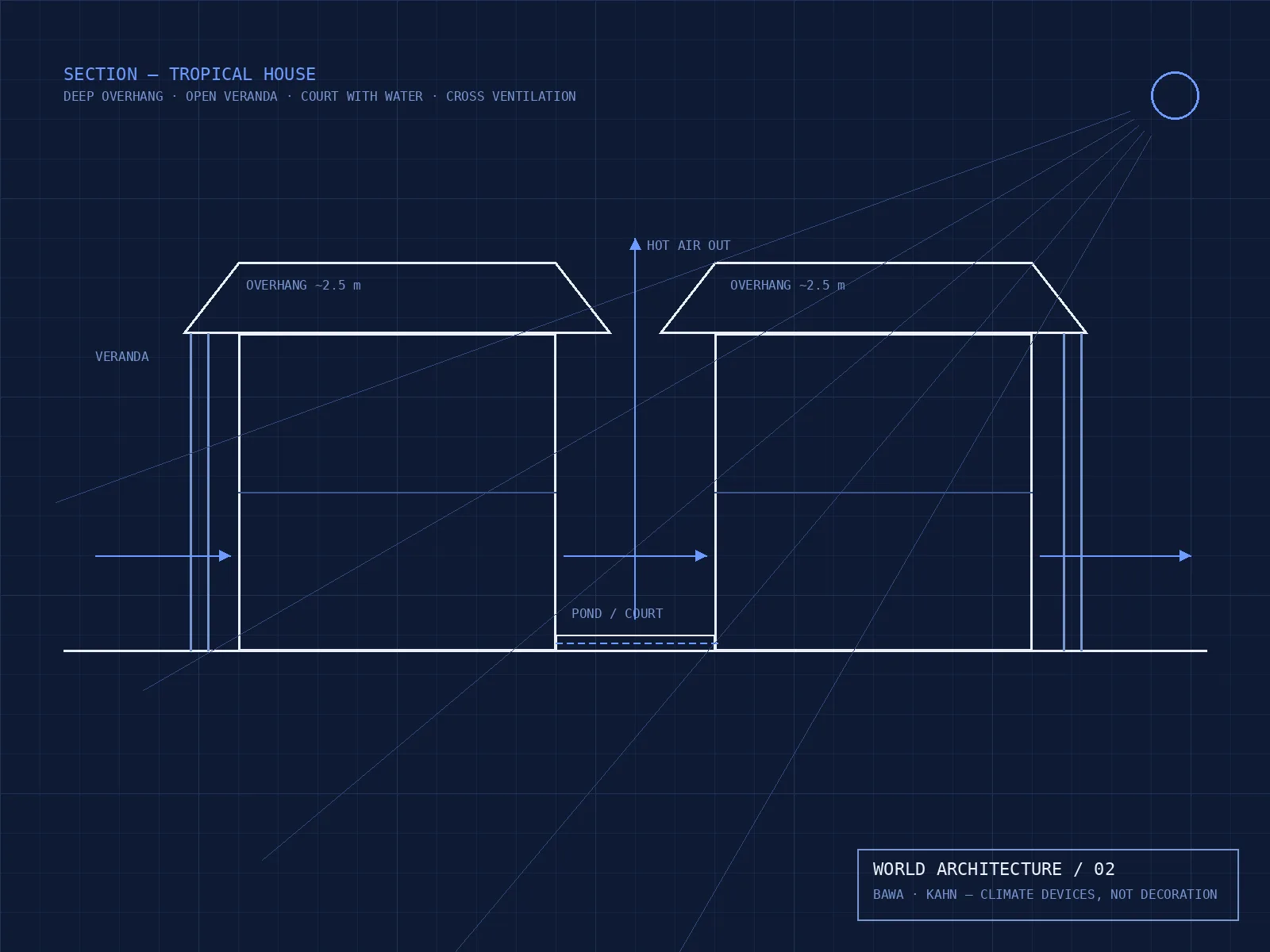
Deep overhangs. A wall that is in shade all afternoon is a wall that is not heating the room behind it. Bawa’s roofs overhang by metres, not centimetres. On our own projects, the terrace that gets used is the one under a roof.
Cross ventilation, planned. Air moves through a house only if it can get in on one side and out the other. This is decided at the plan stage — where the stair goes, whether the family living room has openings on two walls — and cannot be fixed later with a bigger fan.
Courtyards and light wells. On a narrow plot, an internal court is the only way to get daylight and air into the middle of the house. It costs floor area. It is worth it.
Water next to the building. Kahn’s parliament sits in a lake; Bawa’s houses have ponds by the veranda. Air passing over water cools. A small reflecting pool at the entrance of a villa in Cox’s Bazar is not a luxury — it is a climate device that also happens to be beautiful.
Screens instead of glass. Kahn’s concrete cut-outs, the traditional jali, a brick screen wall: all of them let air and diffused light through while keeping the sun off. Full-height glass facing west does the opposite, and no amount of tinting fixes it.
Why it matters now
Electricity is not getting cheaper. A house that needs the air conditioner running from March to October is a house with a permanent bill attached. The architects above showed, decades ago, that the alternative is not a worse house — it is usually a better one.
None of it is nostalgia. It is the most practical set of instructions for building in this climate that anyone has written.