World Architecture
How the Burj Khalifa stands on sand — and what it teaches a 10-storey building in Dhaka
The tallest building on earth sits on ground no better than a Dhaka riverbank. The answer was not a bigger foundation — it was a smarter shape.
The problem
Dubai is built on sand and weak sedimentary rock, with groundwater close to the surface. When the Burj Khalifa was designed in the early 2000s, the engineers (Skidmore, Owings & Merrill, with Bill Baker leading the structure) had to put more than 800 metres of tower onto ground that would not carry a conventional footing.
If that sounds familiar, it should. Much of Dhaka, Narayanganj and the whole delta sits on soft alluvial soil with a high water table. The scale is different; the problem is the same.
What they did
Three decisions carry the building.
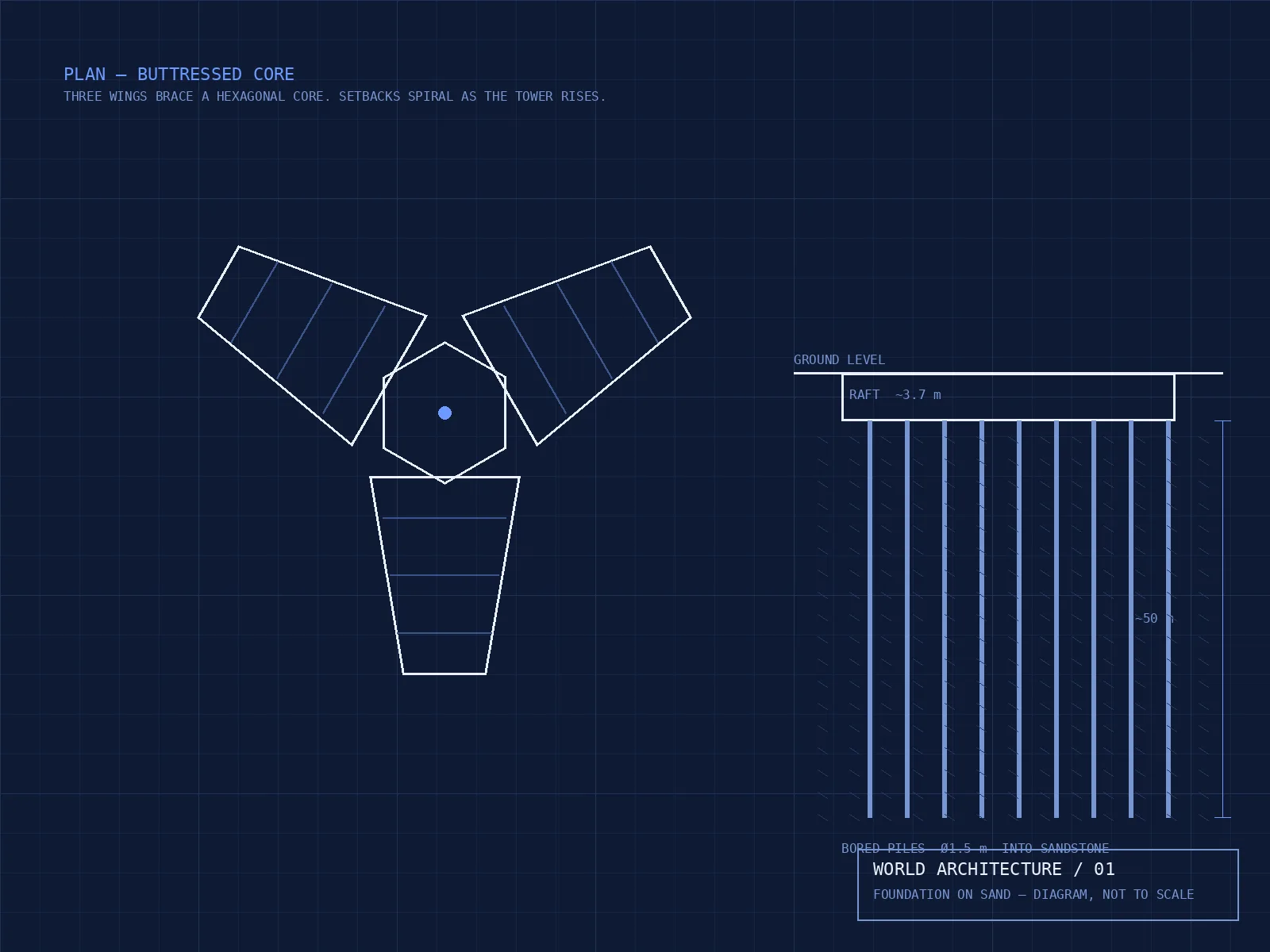
Piles, not a footing. The tower stands on a group of bored reinforced-concrete piles, each about 1.5 metres in diameter, driven roughly 50 metres into the ground. On top of them sits a raft of concrete nearly 4 metres thick. The building’s weight is not resting on the surface at all — it is carried down to a depth where the ground can take it.
A shape that resists wind by itself. The plan is a Y — three wings around a hexagonal core. As the tower rises, the wings step back in a spiral. This is not decoration: the setbacks confuse the wind so that vortices never organise on one face, and the tower does not sway the way a plain box would. The structure is called a “buttressed core”, because each wing braces the other two.
Testing before trusting. Before the design was fixed, the team ran a full wind-tunnel programme and load-tested the piles on site. The drawings changed because of what the tests showed.
What it means for a plot in Bangladesh
Nobody in Bangladesh is building 160 storeys. But every one of those three decisions scales down.
A 6-storey apartment building in Keraniganj on soft ground has exactly the same choice: spread the load on a raft, or carry it down on piles to a firmer layer. Which one is right depends on the soil report — which is why we do not start a foundation design without one. The Burj Khalifa’s engineers did not guess at 800 metres, and there is no reason to guess at 20.
The shape lesson applies too. A slim tower on a 4-decimal plot in Chattogram feels wind. Where the lift core sits, and whether the plan is symmetrical, decides how much the top floors move. It is far cheaper to settle that on the first sketch than to add bracing after the columns are poured.
Big buildings do not use different physics. They just make the physics impossible to ignore.